
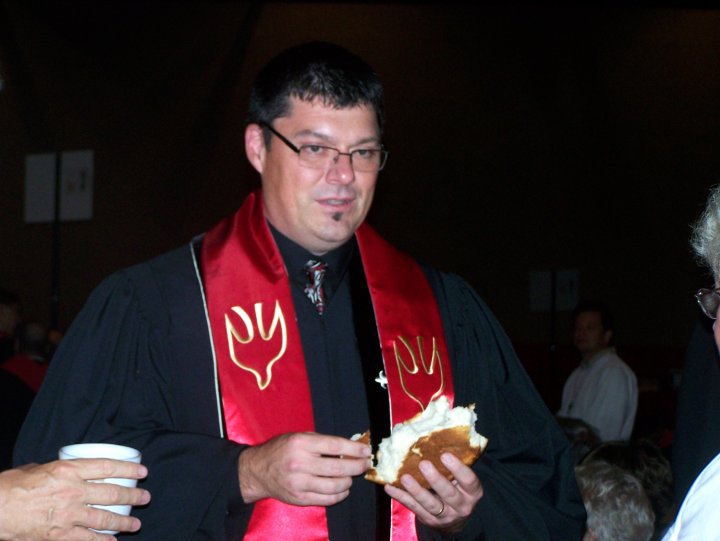
I blogged my way through the United Methodist ordination process up until 2010, when I actually got ordained as an Elder in the Illinois Great Rivers Annual Conference of the UMC. I stepped on a few toes along the way, and stomped on a few others. I received tremendous support from United Methodists all across the country. There were incredible ups and downs.
Then I stopped blogging. The process had been emotionally draining. The primary purpose of that blog was to document the process, even though I often just blogged about my interests and whatever was going through my mind at the time. But I completed that journey on June 4, 2010. That’s reason #1 I took a break. Reason #2 was that my marriage fell completely apart and I got divorced within two months. I didn’t want to blog because those emotions and experiences were better dealt with out of the public eye.
But let’s begin with why I’m writing this. David F. Watson, Associate Professor of New Testament and Academic Dean of United Theological Seminary, put up this tremendous blog post about rethinking the entire United Methodist ordination process, and it has sparked incredible discussion (at least in my little corner of the Facebook world).
Watson, in his piece, identifies two massive problems with the process:
- In Watson’s words: “…the biggest problem with our ordination process is that it is not undergirded by a clear theology of ordination.Begin with ¶ 301 in the Discipline. There is considerable discussion of what the ordained should do. There is little or no discussion of what ordination is. How can we have a fair process or ordination when we have no agreed upon theological understanding of what our bishops are doing when they ordain? It’s no wonder that our process is given to arbitrary criteria that can vary from conference to conference, team to team. As a church, we need to get clearer about what ordination is.”
- Again, in his words: “…clergy burnout. As a seminary professor and dean, one of the most common problems I see among my students is that they don’t know what the parameters of their jobs are. Too often, young pastors think that their job is everything. It isn’t. The primary role of a pastor is to bring people into relationship with God, to bring the Holy into the ordinary lives of women and men. Without without a clear sense of the ministry into which they are ordained, pastors will be much more prone to leave the ministry.”

Now, I’d be the first to tell you that we need a serious reformation of the ordination process in our denomination. Our candidates don’t fully understand it. Our boards don’t understand it. Our congregations don’t understand it. The process is so time- and energy-consuming, so cumbersome, so difficult to navigate that it causes burnout on its own aside from the day-to-day stresses of ministry.
Here’s a brief summary of my frustrations with the experience.
- We (my ordination class) were required to participate in a Residence in Ministry program that, to be fair, was in its infancy, and the representatives from the Board of Ordained Ministry who were running it did not have clearly defined goals, objectives, or vision of what the program should entail. They were making it up as they went along (because they kind of had to), and the cracks were definitely visible to those of us in the program. There was too much time spent on exercises that had little to do with ordination, and not enough was spent on the things that would actually help us (like understanding their expectations for our written work and our interview skills).
- My required psychological evaluation was lost. Twice.
- A representative from the Board visited me in seminary once in the four years I attended. Did they know I existed?
- I submitted an appeal to my Conference Board of Ordained Ministry to waive my Conference’s CPE requirement in my case, because I was a Licensed Clinical Professional Counselor, with nine years of clinical experience under my belt. I wasn’t a pastor who needed training in clinical skills; I was a licensed clinician becoming a pastor. My appeal was denied twice.
- Re: #4: I spoke to several members of the Board privately, all of whom agreed that making me take CPE was ridiculous. To my face. When the time came for the Board to address the issue, I wasn’t invited to the meeting to attempt to make my case to them. I didn’t even know when the meeting was. The secrecy made it feel creepy, and there’s something simply unjust about being unable to represent or defend yourself to a board making decisions about your life.
- Re: #4 again: I completed CPE. The director of the CPE program asked me at my interview why on earth, with my clinical experience, I would need it. I told him that my board required it.
- By the end of my residency, it became obvious that the Board was more interested in the process than in the candidates who were part of it. I felt neither supported nor encouraged. I would describe my relationship with the BoOM during my residency as adversarial.
Honestly, it was an emotionally wrecking experience. I don’t expect our Conferences to mollycoddle us through the process, but it shouldn’t feel like The Hunger Games, with the game makers (BoOM) throwing up obstacles and additional hoops for us to jump through, either.

We’ve got to reform this process. And when I say reform, I don’t mean tweak it. I mean clean out the fridge. Take everything out, scrub the fridge, and start putting back only the bits that belong. And throw everything else onto the compost heap, down the garbage disposal, into the trash. I’ve seen the UMC lose good candidates to other denominations because of our entirely-too-cumbersome process and our devotion to it. I’ve seen it breed bitterness and cynicism among those who have completed it.
So, yeah, I’ve got an opinion or two.
 Joy in a Minor Key