The United Methodist Ordination Process, Part 2: Redefining Fairness

“For the kingdom of heaven is like a landowner who went out early in the morning to hire laborers for his vineyard. After agreeing with the laborers for the usual daily wage, he sent them into his vineyard. When he went out about nine o’clock, he saw others standing idle in the marketplace; and he said to them, ‘You also go into the vineyard, and I will pay you whatever is right.’ So they went. When he went out again about noon and about three o’clock, he did the same. And about five o’clock he went out and found others standing around; and he said to them, ‘Why are you standing here idle all day?’ They said to him, ‘Because no one has hired us.’ He said to them, ‘You also go into the vineyard.’ When evening came, the owner of the vineyard said to his manager, ‘Call the laborers and give them their pay, beginning with the last and then going to the first.’ When those hired about five o’clock came, each of them received the usual daily wage. Now when the first came, they thought they would receive more; but each of them also received the usual daily wage. And when they received it, they grumbled against the landowner, saying, ‘These last worked only one hour, and you have made them equal to us who have borne the burden of the day and the scorching heat.’ But he replied to one of them, ‘Friend, I am doing you no wrong; did you not agree with me for the usual daily wage? Take what belongs to you and go; I choose to give to this last the same as I give to you. Am I not allowed to do what I choose with what belongs to me? Or are you envious because I am generous?’ So the last will be first, and the first will be last.”  (Matthew 20:1-16 (New Revised Standard Version)

If the United Methodist Church is going to take reforming its ordination process seriously, we’re going to have to take the concept of fairness seriously as well.  I’ve heard it over and over: “what we do for one candidate, we have to do for everyone. It’s only fair.”  This definition and understanding of fairness is part of what has turned the UM ordination process into such a mess.  Everyone abides by the same process, everyone completes the same requirements, everyone goes through the same obstacle course if they want to be ordained.

And, in the interest of fairness, the obstacle course keeps getting bigger.  In a well-intentioned attempt to make the process comprehensive and produce complete, well-rounded ordinands, we add more and more requirements to the mix.  For example, all candidates in at least one conference have to take a basic literacy exam, whether they failed to complete high school or have a Ph.D. Every. Single. One.

Why?  Because if one candidate has to do it, they all have to do it. That’s only fair.

In our conference, a Ph.D. psychologist would have to take CPE in order to get through residency.  Why?  Because some candidates really need some clinical training, and if some have to do it, all have to do it.  That’s only fair.

Except it isn’t fair. Not at all.

In the above parable from Matthew, Jesus rips apart that concept of fairness. When some workers complain, “We worked longer hours, how are they getting paid the same as us?” the manager answers, in essence, “I made a deal with you, and I made a deal with them. What business is it of yours?”

Fairness does not mean that everybody does the same work and receives the same reward.  A better theological understanding of fairness is that everyone gets what they need.

Under the better definition of fairness the Board of Ordained Ministry would receive each candidate and work to discern their gifts, graces, skills, abilities, and needs – and address them.  Each candidate’s strengths could be built up even stronger.  Potential issues could be assessed and addressed.  Each candidate can be given what he or she needs in order to become the Elders we would all like to see ordained.

What if we were to categorize several facets of a pastor’s job and assess each candidate’s abilities?  Preaching, teaching, Sacraments, evangelism & outreach, pastoral care, time management, administrative duties, running meetings, conflict management, worship design, wedding planning, funeral planning (to name a few).  Some pastors are excellent preachers and pastoral caregivers but lousy administrators. Some are great administrators and good preachers, but need to learn skills for pastoral care.  Others may be excellent at pastoral care and administration, but their preaching needs help.  Think about the pastors you’ve had in your life: they weren’t all as well-rounded as we’d like to think our current process makes them, were they?

The Conference BoOM should absolutely have the authority to require CPE of candidates who need skill-building in pastoral care.  No question.  But they should also have the authority to require that some candidates take an additional course or shadow a mentor in preaching, time management, business & administration, or deeper study of sacramental theology instead.

This can communicate to the candidate, “We think you’re going to be a great Elder for the church, so we’re going to help you get what you need to make it so.”

The official document Services for the Ordering of Ministry in The United Methodist Church, 2013-2016 presents a theological understanding of Ordination in the United Methodist Church.  Here’s an important passage from the document:

Ordination is chiefly understood as the act of the Holy Spirit. As a liturgical act,
ordination is also understood as the public prayer of the church confirming the
Spirit’s call to individuals and asking for them gifts and power for the ministry of
deacon or elder (presbyter in some churches).

The rite of ordination is the climax of a process in which the faith community
discerns and validates the call, the gifts, and effectiveness for apostolic ministry
by agency of the Holy Spirit. Always more than a single liturgical moment,
ordination is a full process in which all of the baptized share. The process begins
with the church’s discernment of God’s call to individuals for service as ordained
leaders, continues with support and scrutiny as they prepare for this work,
culminates in electing them to the office and work of a deacon or an elder, and is
celebrated and enacted liturgically in the service of ordination.

I wish our church understood it that way, or at least understood this bit more deeply.  It’s my jaded fear that ordination is not understood in the UMC as an act of the Holy Spirit, but rather an act of the Board of Ordained Ministries based upon a candidate’s successful completion of items on a checklist while managing to not tick off anyone important or rock the boat in any significant way.  Or perhaps it is understood both ways to some degree.

Lest I come across as a cynical, far-too-jaded, bitter man with an ax to grind, let me say this:

  • My cynicism is not as deep as it seems.  I’m not a pure cynic. I’m far closer to a romantic idealist whose heart has been broken.
  • I know lots of people on our Conference BoOM, and I think they’re wonderful people, excellent Elders, and are sincerely trying to do the right thing.
  • I love the United Methodist Church, and I love being an Elder.
  • I think the UMC has ordination problems, but those problems are far from irreparable.  We can fix this.  Otherwise, I wouldn’t say anything.
  • It is my intention to be constructive.  If I don’t come across that way, remember first that I have not yet fully made my case, and second, that redemption and reconstruction often begin with a call to repentance.

The United Methodist Ordination Process: Picking at Old Wounds

I blogged my way through the United Methodist ordination process up until 2010, when I actually got ordained as an Elder in the Illinois Great Rivers Annual Conference of the UMC.  I stepped on a few toes along the way, and stomped on a few others.  I received tremendous support from United Methodists all across the country.  There were incredible ups and downs.

Then I stopped blogging.  The process had been emotionally draining.  The primary purpose of that blog was to document the process, even though I often just blogged about my interests and whatever was going through my mind at the time.  But I completed that journey on June 4, 2010.  That’s reason #1 I took a break.  Reason #2 was that my marriage fell completely apart and I got divorced within two months.  I didn’t want to blog because those emotions and experiences were better dealt with out of the public eye.

But let’s begin with why I’m writing this.  David F. Watson, Associate Professor of New Testament and Academic Dean of United Theological Seminary, put up this tremendous blog post about rethinking the entire United Methodist ordination process, and it has sparked incredible discussion (at least in my little corner of the Facebook world).

Watson, in his piece, identifies two massive problems with the process:

  1. In Watson’s words:  “…the biggest problem with our ordination process is that it is not undergirded by a clear theology of ordination.Begin with ¶ 301 in the Discipline. There is considerable discussion of what the ordained should do. There is little or no discussion of what ordination is. How can we have a fair process or ordination when we have no agreed upon theological understanding of what our bishops are doing when they ordain? It’s no wonder that our process is given to arbitrary criteria that can vary from conference to conference, team to team. As a church, we need to get clearer about what ordination is.”
  2. Again, in his words:  “…clergy burnout. As a seminary professor and dean, one of the most common problems I see among my students is that they don’t know what the parameters of their jobs are. Too often, young pastors think that their job is everything. It isn’t. The primary role of a pastor is to bring people into relationship with God, to bring the Holy into the ordinary lives of women and men. Without without a clear sense of the ministry into which they are ordained, pastors will be much more prone to leave the ministry.”

Now, I’d be the first to tell you that we need a serious reformation of the ordination process in our denomination.  Our candidates don’t fully understand it.  Our boards don’t understand it.  Our congregations don’t understand it.  The process is so time- and energy-consuming, so cumbersome, so difficult to navigate that it causes burnout on its own aside from the day-to-day stresses of ministry.

Here’s a brief summary of my frustrations with the experience.

  1. We (my ordination class) were required to participate in a Residence in Ministry program that, to be fair, was in its infancy, and the representatives from the Board of Ordained Ministry who were running it did not have clearly defined goals, objectives, or vision of what the program should entail.  They were making it up as they went along (because they kind of had to), and the cracks were definitely visible to those of us in the program.  There was too much time spent on exercises that had little to do with ordination, and not enough was spent on the things that would actually help us (like understanding their expectations for our written work and our interview skills).
  2. My required psychological evaluation was lost.  Twice.
  3. A representative from the Board visited me in seminary once in the four years I attended.  Did they know I existed?
  4. I submitted an appeal to my Conference Board of Ordained Ministry to waive my Conference’s CPE requirement in my case, because I was a Licensed Clinical Professional Counselor, with nine years of clinical experience under my belt.  I wasn’t a pastor who needed training in clinical skills; I was a licensed clinician becoming a pastor.  My appeal was denied twice.
  5. Re: #4: I spoke to several members of the Board privately, all of whom agreed that making me take CPE was ridiculous. To my face.  When the time came for the Board to address the issue, I wasn’t invited to the meeting to attempt to make my case to them.  I didn’t even know when the meeting was.  The secrecy made it feel creepy, and there’s something simply unjust about being unable to represent or defend yourself to a board making decisions about your life.
  6. Re: #4 again:  I completed CPE.  The director of the CPE program asked me at my interview why on earth, with my clinical experience, I would need it.  I told him that my board required it.
  7. By the end of my residency, it became obvious that the Board was more interested in the process than in the candidates who were part of it.  I felt neither supported nor encouraged.  I would describe my relationship with the BoOM during my residency as adversarial.
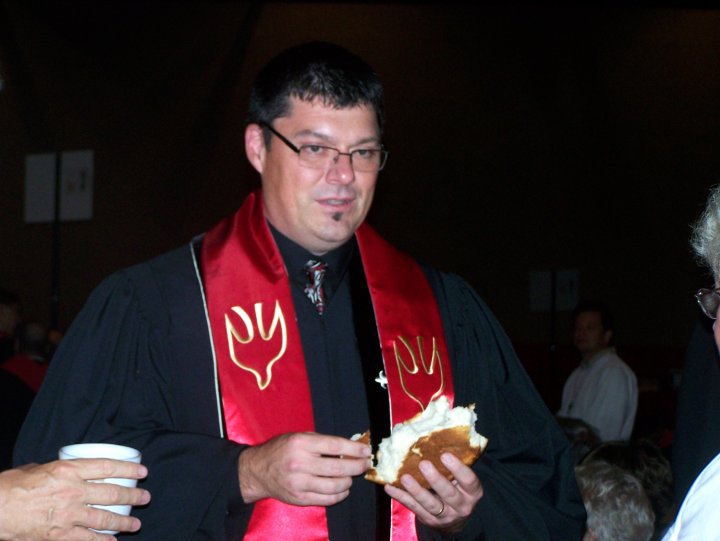
Elder Willie
First time serving communion as an Ordained Elder, at the service at which I was ordained.

Honestly, it was an emotionally wrecking experience.  I don’t expect our Conferences to mollycoddle us through the process, but it shouldn’t feel like The Hunger Games, with the game makers (BoOM) throwing up obstacles and additional hoops for us to jump through, either.

We’ve got to reform this process.  And when I say reform, I don’t mean tweak it.  I mean clean out the fridge.  Take everything out, scrub the fridge, and start putting back only the bits that belong.  And throw everything else onto the compost heap, down the garbage disposal, into the trash.  I’ve seen the UMC lose good candidates to other denominations because of our entirely-too-cumbersome process and our devotion to it.  I’ve seen it breed bitterness and cynicism among those who have completed it.

So, yeah, I’ve got an opinion or two.

Richard Sherman, Loudmouth Winner

I’m married to a Seattle girl.  I love that city and its suburbs.  I love the food, the artistic landscape (there’s art and music everywhere), the open embrace of diversity, the “green all year” climate, the Pike Place Market, the Puget Sound, the fresh salmon, coffee everywhere, and – oh, yes – the woman who fell in love with me and moved along with her daughter (whom I also love dearly) to Illinois to marry me. I love Tiffany’s whole family.  I love her dad in Great Falls, Montana and how he reminds me of my own dad in so many ways.  I love her mom and her stepdad in Seattle.  I also love Tiff’s ex-husband, her daughter’s father, who is gracious, caring, and sweet.  

And there’s the football.  Tiff’s friends and family are Seahawks fans.  I didn’t really follow (or even understand)  football have a team prior to our marriage, but we’ve been excited to watch the Hawks these last few years.  

Our family had a great time Sunday night watching the Seattle Seahawks beat the San Francisco 49ers to advance to the Super Bowl this past Sunday night.  It was an exciting game, a real nail-biter.  It literally came down to the last play in the final seconds of the game.  Colin Kaepernick threw what looked for all the world like a touchdown pass to Michael Crabtree in the corner of the end zone.  But Richard Sherman sprang up and got a hand on the ball before it could hit Crabtree, forcing an interception by Malcolm Smith that helped the Seahawks hold the lead until the clock ran out. 

Then Sherman gave the interview.  You know the one.  And the internet blew up.  It’s still blowing up.  Everybody has an opinion on Richard Sherman’s sportsmanship, character, and attitude.  

And I’m about to give you mine. 

This reflection is based on a book I am currently reading.  It’s called Mindset: The New Psychology of Success by Carol Dweck.  The essential thesis of the book is simple.  There are two basic mindsets that one can adopt, two attitudes toward success and failure that play a huge role in one’s approach to problem-solving and career-building.  The first is called a “fixed” mindset, and it’s the attitude that things like intelligence, problem-solving ability, and talent are innate, fixed characteristics.  Success and failure reflect upon the intelligence, character, and innate abilities of the person.  The second is identified as the “growth” mindset.  Failure is perceived not as a reflection upon one’s character or talent, but as a challenge to learn from and overcome.  Dweck reflects upon the lives and careers of athletes, businesspersons, academics, and others who represent, to one degree or another, each of the two mindsets.  

To make a long story short, failure sends a fixed-mindset person to the cry room.  The fixed-mindset person will make excuses or try and cover up his/her failures.  She or he will take every failure, every loss personally as if it reflects poorly upon their character, talents, and abilities. On the other hand, failure sends a growth-mindset person to the practice field or the woodshed.  

(Of course, this is an oversimplification.  Success begins with an interplay between one’s innate characteristics and chosen mindset, along with a dose of advantages/disadvantages that are beyond each individual’s control.  Those with a growth mindset may be limited to some degree by external disadvantages, but refuse to be defined by them.)

Something tells me that Stanford professor Carol Dweck would place Stanford graduate Richard Sherman in the “growth-mindset” category.  

I started thinking that when I saw this article pop up on my Facebook feed.  From the article: 

Sherman thrived on the field, as well. He played tight end for Dominguez [note: his high school] and attracted scholarship offers (as a receiver) from numerous colleges. Stanford’s academic reputation hooked Beverly [his mother], and its status as a bottom feeder appealed to Sherman’s competitive streak.


“I wanted to go somewhere and be part of the change rather than a place that was already winning,” he said.

Read more: Richard Sherman: What makes him tick? – The Denver Posthttp://www.mercurynews.com/sports/ci_24948663/richard-sherman-what-makes-him-tick#ixzz2r3Mo5Nnn

He chose to attend an academically challenging school and committed himself to doing his part to turn around their football program.  I interpret this as a growth mindset challenge.  Rather than join a team that was steamrolling the competition, Sherman chose a team where he’d have to learn to win.  

Also: 

Sherman’s unrelenting need to prove people wrong developed early. His older brother, Branton, who now serves as full-time business manager, was always his part-time instigator.


“He used to piss me off all the time,” Sherman said with a smile. “He still does. He’ll say, ‘This guy’s way better than you are. He’s going to beat the heck out of you.’


“And I just go out to prove him wrong, like: ‘Shut up! Shut your mouth! I stopped this dude. I stopped that dude.’

“But no matter who I stop, he’ll say, ‘This guy’s rated here. He’s going to go for 200 on you today. He’s better. He’s waaaay better than you.”

It’s that mindset, that attitude that sends Sherman to the practice field, that motivates him to push himself harder, work longer hours, to face each game as a challenge to rise to and an obstacle to overcome.  

Sherman grew up and attended high school in Compton.  He was a straight-A student, salutatorian of his graduating class, completed his Communications degree at Stanford, chose to play a defensive position because, in his words, at defense “you’re in control of your own destiny,” rose above the expectation that he’d be an average NFL player, and pushes himself at every opportunity to improve his game.  After retiring from the NFL, he plans to put his communications degree to use as a sports commentator (he has well-defined career goals for someone who is 25 years old!)

So maybe he comes across as a loudmouth.  But maybe running his mouth is his way of setting goals for himself, raising the bar of success so that he’s continually challenged to rise above.  And maybe there’s something we can all learn from that.  


A Limited Time Offer

Every month I write a church column for the local newspaper.  Here’s this month’s entry.  

“You’ve got three years, starting today.”  That was the challenge issued by a friend of mine several years ago.  “Imagine you got a call from the Bishop, and he told you that you have three years left in your current church.  And you will not be replaced by a new pastor.  What’s your plan for leaving behind a church that is vital, self-sustaining, spirit-guided, thriving, and growing?” 

Think about that from your perspective.  What if the powers-that-be in your church told you that after three years you’re losing your pastor, there will be no new pastor, and that your church is expected to be vital and growing anyway?  What does that vital and growing future look like?  Who is doing the work of the church?  Who’s visiting the sick?  Who’s leading book studies and Bible studies?  Who’s working with the kids and young families?  Who’s giving the Sunday message?  Who’s following up with new visitors?  Who’s keeping the calendar?  Who’s in charge of music? 

I experienced that once.  My pastor died while he was serving our church.  He was a great leader and a courageous man.  Unfortunately, he was also a man with serious heart problems.  We all knew his health was a concern, so members of our congregation took over pieces of what we thought was the pastor’s job.  And when he died, we were left without a pastor for six months.  And during those six months the church actually grew.  We discovered that much of what we thought was his job was really the church’s job, our job.  We learned to be a church, and in doing that we learned that ministry is everybody’s business. 

If you are a member of a church, then you are (or should be) in ministry.  What is your ministry?  To what kinds of ministry do you feel called?  To whom can you look for guidance in discerning your call?  And what if you only had three years to prepare your church for vitality without pastoral leadership?  Blow your pastor’s mind sometime: march into his or her office and ask, “How can I help you?” Then take up that ministry with a sense of urgency and joy.

Act now.  Time’s a-wasting. 

Cleaning Out the Fridge

Today marks the 496th anniversary of Martin Luther’s bold act of nailing 95 Theses to the door of Castle Church at Wittenberg, providing the public kickoff for the Protestant Reformation. (Some historians would argue, I believe rightly, that the reformation was already brewing but Luther’s act gave the movement a public voice and a tangible jolt.)  For Reformation Day, I thought I’d reflect a little here. 

I once read an interesting simile for the Protestant Reformation.  I wish I knew to whom to attribute it.  It goes something like this: 

Reformation movements are like cleaning out the refrigerator. There are two ways of doing it. You can throw out everything that is rotten, spoiled, or out of date, leaving only the good stuff. Or you can empty the whole thing, wash it down, and put back only what belongs. Luther did the former, Calvin the latter. 

What died in here? 

I’m not going to argue the veracity of the last statement, but I think the image is cool.  As the pastor of a church that is struggling to grow and looking for direction, I wonder which reformation path I should take in the coming year. Do I help the church let go of what’s not working?  Or do we strip it down to the bare essentials and only put back what does work? How radical do we want to get? 

Because there’s a truth that churches don’t want to deal with.  They don’t want to hear it, see it, face it, or think about it. That truth: change is inevitable. There is no such thing as standing still. There is only progressing and regressing. If you attempt to stand still you will regress because time marches on right past you. Change can be forced, it can be navigated, it can be coped with, or we can live in denial of it. But it’s a reality we have to deal with, and the choice is ours. Do we embrace it or do we stick our fingers in our ears and go, “LALALALALALALALA!”

Through the scriptures, we are constantly told that God is “doing a new thing” and “making all things new.” God is portrayed as taking what is dead and motionless, and giving it new life, setting it back in motion. God is never portrayed as a museum curator, propping up what is dead and displaying it as though it is alive. Therefore, we have miniature reformation movements in our own lives, in our own churches, in our own communities. Every fridge needs cleaned out on a fairly regular basis! 

Where have you seen reformation at work in your own church? Feel free to respond and discuss! 

The Preacher as Songwriter: Like a Rolling Stone

For years, I’ve pondered writing a book about the link between preaching and songwriting.  I’ve never gotten around to hammering out the time to begin the hard work of organizing my thoughts, writing drafts of chapters, and getting it done.  But the idea still haunts me. 

See, I believe preachers have a lot to learn from songwriters, beginning with the profound insight that all your songs shouldn’t sound the same.  In fact, they shouldn’t all come from the same place.  

Some songs are sung in the confessional or at the altar of shame.  “I didn’t mean to hurt you.  I’m sorry that I made you cry.  I didn’t want to hurt you.  I’m just a jealous guy.” – John Lennon

Some songs are blues.  Some are funny.  Some are happy.  Some proclaim triumph in the life of the singer.  Some protest social conditions.  Deep love, heartbreak, betrayal, reconciliation, sweetness, anger, irony, longing, passion, desire, and shame are the playground of the lyrical wordsmith.  Some tell stories of real-life characters.  Some tell stories that are allegories for part of the human condition.  Some are brags and boasts.  Some songs are stream-of-consciousness absurdity.  Some exist only to entertain.  

And sermons should work in the same ways.  In fact, it’s the variety of an artist’s work that makes us feel like we know that artist better.  A clearer picture of Elvis Costello emerges when you mix the achy tenderness of Alison with the jaded anger of a heartbroken idealist (What’s So Funny); when you place his whimsical tale of marriage and divorce (Everyday I Write the Book) alongside the darker Indoor Fireworks, and hold them up against the very real love song She.  

But let’s take a look at perhaps the most iconic song in rock and roll: Like a Rolling Stone by Bob Dylan

It’s considered iconic because it broke all the rules.  It was a 6 minute single at a time when singles had to be under 3:30.  It was an electric song by a primarily acoustic artist, at a time when Dylan’s audience considered his break with the orthodoxy of folk music a betrayal.  It wasn’t a love song or a typical break-up song, or an entertaining piece of zip-a-dee-doo-dah.  The character to whom Dylan is singing isn’t just a character – he or she is a target, the recipient of his anger and vitriol.  It was filled with real emotion, real pain.  You can hear the hurt, anger, shock, bitterness, desperation, and desire for revenge in his repeated yowls of “how does it FEEL?”  The wound is fresh, the emotion is raw, the tears are salty.  He sounds like he wants to scream.  Or cry.  Or both.  

Other songwriters heard it and realized that the game had changed.  Nothing was off limits anymore.  Time limitations? Gone.  Bowing to the expectations of your primary audience?  Exploded.  Veiling emotion with a layer of metaphor?  NO!  

And why is it considered so iconic? So important in the history of rock?  Because it connected with people. They could relate to it. Dylan was giving language to emotions we feel and have difficulty expressing. A generation of rock fans breathed a sigh of relief when they realized that someone else gets it, somebody knows how I feel! The lyrics are ugly, sharp, bitter; yet ultimately relatable.  Anyone who has been betrayed or hurt knows what it’s like to hear those words and wish they could say them.  

Shouldn’t preaching be like that occasionally?  An honest life of discipleship is hard.  It’s filled with betrayal. Tears do happen. Wounds that leave ugly scars are inflicted upon us. Sometimes we all want to flail our fists in the air, punching at ghosts, hoping that connecting with one will satisfy our emotional longing. We all long to hear a voice who longs for love railing in anger against that which is not love.  

Now, a screed is not a sermon.  No matter how angry we might be. But it is essential that the preacher find a point of connection with the real emotions and experiences of the listeners in the congregation. We are up there at the pulpit to be (among many things) the voice of the voiceless.  To help give language to experiences that are hard to describe with words.  

So sing a song that makes the congregation say, “wow, somebody GETS IT!”  

Maybe sometimes the first question we should ask ourselves when we sit at the keyboard to compose our sermons is, “how does it FEEL?”

Focus on Processes, Not Outcomes

If you’re in a leadership position of any kind and you haven’t read Seth Godin’s blog, you really should.  His brief little insights are really profound and helpful.  Here’s a bit today’s entry on the problems with cynicism:

Someone betting on the worst outcomes is going to be correct now and then, but that doesn’t mean we need to have him on our team. I’d rather work with people brave enough to embrace possible futures at the expense of being disappointed now and then.


Don’t expect kudos or respect for being a cynic. It’s selfish.

You can read the rest by clicking here

It’s important to recognize cynicism for what it really is – a defense mechanism.  The cynic attempts to shield him/herself from the heartbreak of disappointment by expecting disappointment in the first place.  And that can be effective. However, it often sets up a self-fulfilling prophecy, skewing the results of your efforts.  Go into a project expecting failure, and you’ll get failure more often than not.  

It is an alluring trap, though.  “If I expect failure, I’m not disappointed when a project fails. If it succeeds, it’s a pleasant surprise!” In a team situation, that attitude focuses all your attention on yourself and your own emotions.  It places your feelings above the team’s efforts.  

I’ve never heard a hitting coach tell a batter, “Step into the box expecting to strike out.  That way you won’t be disappointed when you do.”  

Instead, hitting coaches tell hitters to think about where they want to hit the ball, to look for the pitch that will help them put it there, and remind them of their swing mechanics.  Their focus is on the process that can lead to the desired outcome. Cynics and tend to focus on outcomes.  

When you design a plan for your churches, do you focus on the process or the outcome?  Sure, each plan has a desired outcome.  The best plans have ways of realistically measuring those outcomes.  But from the get-go, it’s essential not to become cynical and selfish.  Focus on the process.  Evaluate the results later.  


Muddy Waters and Biblical Interpretation

Okay, stick with me here. 

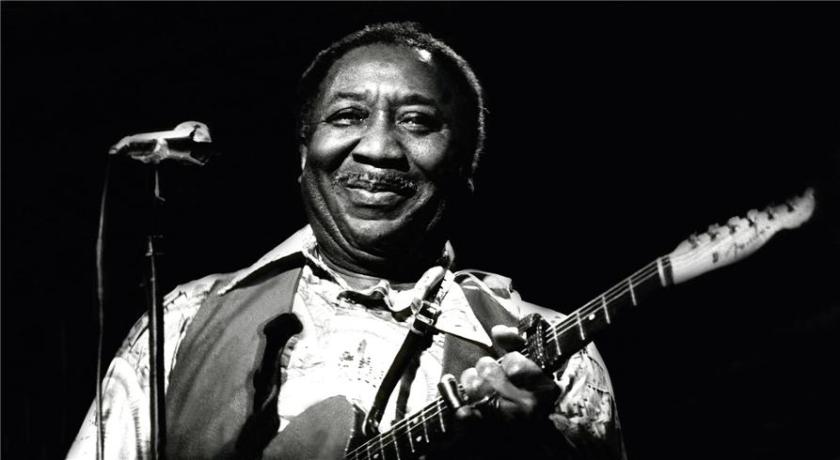
I became a blues fan in the 1980s during the huge blues revival ushered in by Stevie Ray Vaughan, the Fabulous Thunderbirds, and Robert Cray. My dad became a blues fan during the huge blues revival of the 1960s ushered in by the Rolling Stones, the Yardbirds, the Animals, and others.  During each revival, something wonderful happened. The original blues artists who inspired the young guns also saw tremendous surges in their popularity. Eric Clapton, the Stones, Johnnty Winter, Jimmy Page, and Jimi Hendrix sent music fans to the shops and the clubs after the music of Muddy Waters, Howlin’ Wolf, Robert Johnson, B.B. King, John Lee Hooker, and Jimmy Reed. Freddie King started having hit records. Bo Diddley was a huge concert draw. Later on in the 1980s, Stevie Ray Vaughan fans rediscovered Buddy Guy, Albert Collins, Lonnie Brooks, Johnny Copeland, and KoKo Taylor.

Muddy Waters, in particular, was fond of calling his disciples his sons.  He claimed Eric Clapton and Johnny Winter as his sons.  This was obviously not a biological claim, but rather a recognition that these “sons” of his were the bearers of his tradition and legacy. Clapton and Winter revered Waters and his work, and kept his music alive. Muddy knew that his music was safe in the hands of his “sons.” Muddy knew his music, his tradition, his legacy would live well beyond his body because they had been passed to his sons, who would then pass it to their own sons and daughters. 

I love the Bible. I love the passages that look to our eyes like genealogies. My theological mind can’t help but wonder sometimes if the genealogical lists in the Holy Scriptures are something beyond biological records. We tend to read them as standard genealogies because they look to our modernist minds like genealogies. But what if the claims put forth by these lists are not biological but rather theological? What if the lists in the opening chapters of Matthew and Luke are meant to be taken as theological genealogies rather than biological ones? What if Jesus is the “son of David” in a way similar to how Derek Trucks is the son of Duane Allman, who is the son of Elmore James, who is the son of Robert Johnson?  

Sometimes language works in ways that go beyond the literal. Metaphors don’t always let you know they’re metaphors. (If they did, they’d cease to be metaphors; they’d be similes.) To limit the function of language to the literal is to rob it of much of its power. If we interpret all language as literal, we’ve sucked the life out of poetry

I could be completely wrong here, and I’m sure there are many within my denomination and tribe who would deem it necessary to “correct” me.  But I’m not trying to explain away any sort of inconvenient Biblical truths here. In fact, I’m seeking to find deeper meaning in passages that can be approximately as interesting as long division or watching mulch decompose. I’m not trying to say that Jacob (Israel) is not literally the son Issac and the grandson of Abraham; I’m choosing to focus on how the imago dei passed from Abraham to Isaac to Jacob.  Because I believe that the passing of imago dei through generations is far more important than passing DNA. But that’s just me. 

Johnny Winters is Muddy’s “son.”  Eric Clapton is Muddy’s “son.”  

I graduated from Eden Theological Seminary.  That puts Walter Brueggemann, Reinhold Niebuhr, and Richard Niebuhr in my theological genealogy, as well as Damayanthi Niles, Deb Krause, Steve Patterson, Clint McCann, John Bracke, Peggy Way, Joretta Marshall, and a host of others.  I’m United Methodist, which puts John and Charles Wesley in my theological DNA along with their beautifully diverse children from John Cobb, Schubert Ogden, and Marjorie Suchocki to Thomas Oden, William Abraham, and others.  

I’m also a blues-rock guitarist, which makes me a son of Eric Clapton.  And Muddy Waters.

I’m a man.  

I spell, M!  

A, child.

N. 

October is Pastor Appreciation Month

For Pastor Appreciation Month, I thought I’d follow my friend and colleague’s lead and list some of the pastors who have helped shape my faith and my life.  

From my home church, First United Methodist of Carrier Mills, IL

  • Steve Palmer was the first pastor with whom I had a connection.  He had a passion for our UMYF, and was my pastor when I took my first steps into faith.  His wife Linda held my hand as I prayed at the altar at Beulah Youth Institute (church camp) when I first gave my life to Jesus. 
  • Tom Richards was our pastor when my brother and I were confirmed and baptized. 
  • Harold (Red) Andricks led our church through a period of transformation.  He taught us how important it is for the laity of the church to own its ministries.  In many ways, he taught us how to be a church.  He also helped lead my dad into a life of faith, and baptized my daughter Caitlyn. 
  • Victor Long led our church into and through a time of tremendous vitality. He also mentored me in the early stages of my ministry inquiry process.  He taught me Lectio Divina, the Liturgy of the Hours, and showed me how theology really matters in the life of the church.  He remains a friend, trusted colleage, and a personal mentor to me.  My admiration for Victor is tremendous. Victor also baptized my sons, Anthony and Carter. 
  • Deb Pollex entered the ministry process at approximately the same time as me.  Her meditative, contemplative, and artistic approach to church leadership, especially youth leadership, is inspiring to me.  Often when designing a worship experience I ask myself, “how might Deb do this?”
  • I also have to mention Joey Dunning and Stan Irvin, who have served CM FUMC since I left.  They have been my family’s pastors and have done tremendous work. 

From other scenes in the Rest of my life

  • Larry Gilbert has been my pastor, my District Superintendent, and my friend.  He taught me a lot about preaching, and helped me understand how deeply human pastors really are.  
  • David Eadie was never my pastor nor a formal mentor, but he was a colleague in a Covenant group during my Provisional Elder years.  His words of support and care during that time are precious to me.  No one has been more supportive of my ministry in our denomination.  He retired the year I was ordained.  During the passing of the lamp from the retirees to the new ordinands, he represented the retiring class and I received the lamp from him as a representative of the ordination class.  
  • Steve Patterson, Damayanthi Niles, John Bracke, Karen Tye, Peggy Way, Joretta Marshall, Diane Windler, Deb Krause, Martha Robertson, Michael Kinnamon, Jesse Williams, Clint McCann, and so many others who taught and guided me at Eden Theological Seminary.  In preparation for ministry, my faith was deconstructed, reconstructed, and built up in ways I could never have anticipated.  
  • Robb McCoy, Robyn Miller, Nelson Pierce, Margaret Redmond, Frank LeBlanc, Carole Barner, Stacy Tate, Kim Shirar, Hope Molozaiy, Jessica Taft, Josh Williams, Grant Armstrong, Brady Abel, Rocky Sheneman, Tony Clark, Joe and Jessica Rowley, Dietra Wise, Jessica Petersen and again… so many more than I can name who were my classmates and friends at Eden.  We made beautiful theology and beautiful music together, and walking through that re-formation process together was pure joy. 
  • Nicole Wiedman-Cox, Robb McCoy (again), Jeremiah Thompson, Josh Williams (again):  AKA Troublemaker’s Corner.  We went through the Residence in Ministry program together and caused all kinds of trouble there.  Now we sit together at Annual Conference and cause trouble.  I love these people more than I can say, and I love having them as friends and colleagues.  
  • Cindy Jones was my DS through thick and thin.  Ordination, divorce, remarriage, closing a church… Cindy has been there with me, sometimes holding my hand and other times holding me up.  She has built and affirmed my leadership skills in ways I can’t even express.  My current DS, Randy Reese, is also wonderful. 
  • Joe Scheets, Annelle Ruemmler, Dan Perry, and Tim Pate are my bandmates in the Rivers of Life Clergy Band, but our relationship is far more than musical.  They are my friends and my favorite Covenant group ever.  

And I’ve only scratched the surface. 

I thank God for so many I have named here, and so many left unnamed.  

How have your pastors affected your life?  How do you plan to show appreciation to them?