Yesterday I received a phone call from a young lady in our community whom our church has helped before. As far as I can discern she has never abused the system. In fact, a couple of years ago she asked the church for a loan. Not a handout, a loan. When I gave her the money she requested and explained that it was a gift and she did not have to pay it back, she insisted it was a loan and she would be back in a few days to repay us. And true to her word, she did.
So back to yesterday. She called asking if there was any way we could help her with gas money because her father-in-law (who lives with her) had a serious medical issue that needed to be taken care of right away but his specialist is in a town an hour and a half away. I told her that the church would buy her gas and she could come by the office to pick up the money.
I hung up the phone, sat it down, and it rang again. Same number. Her husband was on the line, obviously tearful and full of gratitude. “I just want to thank you, Pastor Willie. Every time we’ve needed help, you’ve come through for us. I love you. My dad and I will be at the service on Sunday. I’ve never had a church show us this kind of love before. Thank you.”
Later last night, the guy who coordinates the Narcotics Anonymous meetings at our church stopped by the parsonage to drop off some money. Every month the NA group gives us a few bucks to thank us for giving them space for their meetings. In the years I’ve been here, I’ve developed a rapport with this guy and I think he grasps that I just view him as a person not as his past. As he handed the money to me, he again thanked me for everything our church does for them, and out it came: “I love you, Willie. Thanks again for everything.”
We’re far from the biggest church in this little town. It would be easy to focus on our struggles and our challenges. But yesterday was evidence that we are bearing good fruit. There really is something to that love, grace, mercy thing.
“There’s just something about a bunch of clergy singing together.”
That’s what my friend and clergy colleague said to me during the Clergy Session at Annual Conference this year. My colleague was right – when we sang “For All The Saints” at the end of the memorial service that closes Clergy Session, we sounded fantastic. Our voices boomed and echoed and soared as we offered our music to the skies.
From there we went to the big room – the floor where clergy and laity gather to do the legislative and decision-making business of Annual Conference. Those voices that had blended together so beautifully, so harmoniously would, over the next three days, disagree. Sometimes we’d disagree amicably. Other times contentiously. Those voices would speak out loudly, angrily, tearfully, woefully, prayerfully, and woundedly. Some voices spoke into the microphone, others only under their breath. Some were arrogant. Some were humble. We don’t agree on everything. Sometimes I wonder if we agree on anything.
But man, when we SING….
When we sing, the diversity of our voices blend into a marvelous sound. When we sing, we sing the same words. When we sing, we sing with each other not against each other. Some sing melody. Some sing harmony. Some sing off-key. Some sing with technical precision. Some sing hesitantly. Some sing heartily. But we all sing together. And it is a joyful noise, a wonderful thing to behold.
A couple of years ago, I bought a great album: The Tel Aviv Session by The Touré-Raichel Collective. It’s a collaboration between guitarist Vieux Farka Touré and keyboardist Idan Raichel. Raichel is Israeli and Jewish while Touré is a Muslim from Mali. Both are devout. Israel and Mali don’t even have diplomatic relations. They’ve now recorded two albums, but there is no logical reason they should work together at all.
Except there’s music.
“Vieux and I are coming from very different worlds. But I think that the magic is to let the music speak out and create bridges between cultures, religion and geographical boundaries,” Raichel said during an interview. During the same interview, Vieux stated, “We want to demonstrate to the world that it is not only possible for Jewish and Muslim people to appreciate each other, but that they are capable of cooperating, collaborating and making something beautiful together. We are just humble musicians, but I hope this can set an example for our politicians to follow.”
Amen, brothers. From one of your Christian brothers.
[Yes, this Christian pastor connects with music recorded by Muslims and Jews. And others!]
There’s something magical about the act of singing together and playing together that transcends our differences. Those differences don’t dissolve completely away, but they become far less important than the song.
I believe that if we want peace among religions and nations, we should learn to stop warring (both figuratively and literally) over beliefs and doctrines, and learn to sing together. Learn one another’s songs. Sing in harmony to open the possibility of living in harmony.
Maybe we should stop trying to merely coexist, and start learning to sing together.
Maybe I’m a bit naive, but I believe music can give us hope that we can live together. Music is one of God’s greatest gifts to us, and perhaps it was given so that we could learn true harmony. It won’t resolve all of our differences, but it sure is harder to hate that person singing so beautifully next to you and with you.
I love working with kids – always have, always will. I get real joy hanging out with them, telling stories, singing songs, forming friendships.
But there’s something about VBS that has always sort of left me baffled.
Why are we doing this? What’s its purpose? Does it succeed in meeting its intended purpose?
**PROCEED WITH CAUTION – Cynicism ahead**
Outreach?: I’ve heard people in congregations I’ve served say, “if we have a really good VBS, maybe we’ll get more kids coming to church.” But that’s never been my experience in VBS from the time I was a kid. When I was a kid, every church kid in town went to multiple VBS programs, while unchurched kids stayed home or went to the local pool or to scout camp. At its best, VBS could succeed in attracting kids to one church from another, failing as an outreach plan but succeeding in perpetuating the membership shuffle.
Christian Education?: others say, “we do VBS so kids can learn more about the Bible.” Fine, but honestly, didn’t the kids just get out of school? Isn’t “no school” the thing they’ve been looking forward to since Christmas? In my experience, the ratio of teaching to behavior management is pretty low. Many kids are far more interested in acting up than sitting through something with “school” in the name. And too often the volunteers’ behavior management strategies are ineffective.
Activity?: some folks operate under the “doing something is better than doing nothing” paradigm. If we don’t have VBS, then it looks like we’re just shutting down. Better to have an ineffective, counterproductive VBS than nothing at all. Is this attitude healthy?
It’s good for the church?: I’ve heard some pastors and active laypersons say, “it doesn’t matter whether we’re reaching any kids. What matters is that our adults are engaging with the kids and young parents in our church family.” I don’t know how it is in your church, but in the places I’ve served I run into an abundance of volunteers who are happy to help in ways that don’t involve working directly with the kids. Getting people to build props and backgrounds, work in the kitchen, donate money and food, design crafts, and clean up – no problem. Getting them to work a teaching station, work on crafts with kids, lead music, and help manage behavior – different story. And (deep cynicism warning) far too often those who sign up with no intention of working directly with children are the ones who are most insistent that we hold VBS and are critical of the way it’s being run by those who are with the kids.
It gives parents of young children a break?: Give ME a break! Again, in my experience It’s usually the parents of young children who are working hardest at VBS.
So if VBS is often ineffective as an outreach program, an education program, and a break for young families, what is it for?
The only reason I can think of is the best one: LOVE.
The one and only purpose of VBS is to communicate to the children of our church and our community that we love them.
We love them even when they don’t pay attention in class. We love them even when their behaviors are difficult to manage. We love them even when they’re more interested in clowning around than in making a doorknob hanger. We love them even when they miss mommy and cry to go home. We love them even when they sing off-key and get the song motions wrong – and even when they do it on purpose.
I think the very best we can hope for at VBS is to give the kids a sense that they are loved. Perhaps one day when they’re older – maybe when they’ve got kids of their own and are looking for a church home – they’ll remember. “That church loved me even when I acted like a turd.”
So this summer, don’t worry about getting through the lessons or getting all the crafts done or getting the songs right. Get the love part right. When you do that, VBS is a success.
A while back I thought I’d start some Facebook discussion by posting this status: “It’s not the spiritual but not religious (SBNR) who worry me, it’s the religious but not spiritual.” The discussion turned to, “how do you define the terms spiritual and religious?”
I think the distinction that I’m looking for is one of substance vs. structure. Spirituality is like the substance of faith – the experience of encountering the Divine, a belief in that which is greater than oneself, a sense of connectedness with creation and its creator. Religion is like an attempt to add structure to that substance: rites, rituals, church buildings, prescribed doctrines, defined boundaries.
At their best, spirituality and religion are beautiful together. My brother and I were baptized together when we were teenagers. We had gone through a confirmation class with our pastor, and the sacrament was administered in accordance with the rituals and disciplines of the United Methodist Church in the midst of a worship service. The religious parts (confirmation, doctrines, rituals) were in place. However, there was something deeply spiritual happening as well. My brother and I had both recently come to a crucial turning point in our faith. We had become Christ-followers and Christ-lovers, where before we had simply been church-goers. The water poured over our heads, the building where we had gathered, and the words of the ritual were deeply religious. The spiritual bit is what made me laugh and cry at the same time and imprinted the experience into my memory.
I believe there’s hope for the church if we tap into both religion and spirituality. We can’t shun one and embrace the other. The world is full of “spiritual but not religious” people. When the church gets it right, we can help the spiritual give structure and discipline to their spirituality. Its substance can take shape through the teachings and practices of the church.
The world is also full of religious but not spiritual people. Some have turned faith into intellectual endeavors, moralistic lists, and inflexible doctrines. The church can help them drink from a deeper well of spirituality and connect with realities greater than themselves.
The hardest part of reaching the RBNS crowd is helping them realize that they’re getting all the dance moves right but missing the beauty of the music.
As a pastor, it’s imperative that I take seriously my leadership in integrating religion and spirituality. I have to attend to both my religious inclinations and my spiritual desires. In order to lead the SBNRs toward the structure of religion, or the RBNSs toward beauty beyond the rules, I must be a model of integrating spirituality and religion.
I am content that these pages show me to be what I am – noisy, full of the racket of my imperfections and my passions, and the wide open wounds left by my sins. Full of my own emptiness. Yet, ruined as my house is, You [God] live there!
“For the kingdom of heaven is like a landowner who went out early in the morning to hire laborers for his vineyard. After agreeing with the laborers for the usual daily wage, he sent them into his vineyard. When he went out about nine o’clock, he saw others standing idle in the marketplace; and he said to them, ‘You also go into the vineyard, and I will pay you whatever is right.’ So they went. When he went out again about noon and about three o’clock, he did the same. And about five o’clock he went out and found others standing around; and he said to them, ‘Why are you standing here idle all day?’ They said to him, ‘Because no one has hired us.’ He said to them, ‘You also go into the vineyard.’ When evening came, the owner of the vineyard said to his manager, ‘Call the laborers and give them their pay, beginning with the last and then going to the first.’ When those hired about five o’clock came, each of them received the usual daily wage. Now when the first came, they thought they would receive more; but each of them also received the usual daily wage. And when they received it, they grumbled against the landowner, saying, ‘These last worked only one hour, and you have made them equal to us who have borne the burden of the day and the scorching heat.’ But he replied to one of them, ‘Friend, I am doing you no wrong; did you not agree with me for the usual daily wage? Take what belongs to you and go; I choose to give to this last the same as I give to you. Am I not allowed to do what I choose with what belongs to me? Or are you envious because I am generous?’ So the last will be first, and the first will be last.” (Matthew 20:1-16 (New Revised Standard Version)
If the United Methodist Church is going to take reforming its ordination process seriously, we’re going to have to take the concept of fairness seriously as well. I’ve heard it over and over: “what we do for one candidate, we have to do for everyone. It’s only fair.” This definition and understanding of fairness is part of what has turned the UM ordination process into such a mess. Everyone abides by the same process, everyone completes the same requirements, everyone goes through the same obstacle course if they want to be ordained.
And, in the interest of fairness, the obstacle course keeps getting bigger. In a well-intentioned attempt to make the process comprehensive and produce complete, well-rounded ordinands, we add more and more requirements to the mix. For example, all candidates in at least one conference have to take a basic literacy exam, whether they failed to complete high school or have a Ph.D. Every. Single. One.
Why? Because if one candidate has to do it, they all have to do it. That’s only fair.
In our conference, a Ph.D. psychologist would have to take CPE in order to get through residency. Why? Because some candidates really need some clinical training, and if some have to do it, all have to do it. That’s only fair.
Except it isn’t fair. Not at all.
In the above parable from Matthew, Jesus rips apart that concept of fairness. When some workers complain, “We worked longer hours, how are they getting paid the same as us?” the manager answers, in essence, “I made a deal with you, and I made a deal with them. What business is it of yours?”
Fairness does not mean that everybody does the same work and receives the same reward. A better theological understanding of fairness is that everyone gets what they need.
Under the better definition of fairness the Board of Ordained Ministry would receive each candidate and work to discern their gifts, graces, skills, abilities, and needs – and address them. Each candidate’s strengths could be built up even stronger. Potential issues could be assessed and addressed. Each candidate can be given what he or she needs in order to become the Elders we would all like to see ordained.
What if we were to categorize several facets of a pastor’s job and assess each candidate’s abilities? Preaching, teaching, Sacraments, evangelism & outreach, pastoral care, time management, administrative duties, running meetings, conflict management, worship design, wedding planning, funeral planning (to name a few). Some pastors are excellent preachers and pastoral caregivers but lousy administrators. Some are great administrators and good preachers, but need to learn skills for pastoral care. Others may be excellent at pastoral care and administration, but their preaching needs help. Think about the pastors you’ve had in your life: they weren’t all as well-rounded as we’d like to think our current process makes them, were they?
The Conference BoOM should absolutely have the authority to require CPE of candidates who need skill-building in pastoral care. No question. But they should also have the authority to require that some candidates take an additional course or shadow a mentor in preaching, time management, business & administration, or deeper study of sacramental theology instead.
This can communicate to the candidate, “We think you’re going to be a great Elder for the church, so we’re going to help you get what you need to make it so.”
Ordination is chiefly understood as the act of the Holy Spirit. As a liturgical act,
ordination is also understood as the public prayer of the church confirming the
Spirit’s call to individuals and asking for them gifts and power for the ministry of
deacon or elder (presbyter in some churches).
The rite of ordination is the climax of a process in which the faith community
discerns and validates the call, the gifts, and effectiveness for apostolic ministry
by agency of the Holy Spirit. Always more than a single liturgical moment,
ordination is a full process in which all of the baptized share. The process begins
with the church’s discernment of God’s call to individuals for service as ordained
leaders, continues with support and scrutiny as they prepare for this work,
culminates in electing them to the office and work of a deacon or an elder, and is
celebrated and enacted liturgically in the service of ordination.
I wish our church understood it that way, or at least understood this bit more deeply. It’s my jaded fear that ordination is not understood in the UMC as an act of the Holy Spirit, but rather an act of the Board of Ordained Ministries based upon a candidate’s successful completion of items on a checklist while managing to not tick off anyone important or rock the boat in any significant way. Or perhaps it is understood both ways to some degree.
Lest I come across as a cynical, far-too-jaded, bitter man with an ax to grind, let me say this:
My cynicism is not as deep as it seems. I’m not a pure cynic. I’m far closer to a romantic idealist whose heart has been broken.
I know lots of people on our Conference BoOM, and I think they’re wonderful people, excellent Elders, and are sincerely trying to do the right thing.
I love the United Methodist Church, and I love being an Elder.
I think the UMC has ordination problems, but those problems are far from irreparable. We can fix this. Otherwise, I wouldn’t say anything.
It is my intention to be constructive. If I don’t come across that way, remember first that I have not yet fully made my case, and second, that redemption and reconstruction often begin with a call to repentance.
I blogged my way through the United Methodist ordination process up until 2010, when I actually got ordained as an Elder in the Illinois Great Rivers Annual Conference of the UMC. I stepped on a few toes along the way, and stomped on a few others. I received tremendous support from United Methodists all across the country. There were incredible ups and downs.
Then I stopped blogging. The process had been emotionally draining. The primary purpose of that blog was to document the process, even though I often just blogged about my interests and whatever was going through my mind at the time. But I completed that journey on June 4, 2010. That’s reason #1 I took a break. Reason #2 was that my marriage fell completely apart and I got divorced within two months. I didn’t want to blog because those emotions and experiences were better dealt with out of the public eye.
Watson, in his piece, identifies two massive problems with the process:
In Watson’s words: “…the biggest problem with our ordination process is that it is not undergirded by a clear theology of ordination.Begin with ¶ 301 in the Discipline. There is considerable discussion of what the ordained should do. There is little or no discussion of what ordination is. How can we have a fair process or ordination when we have no agreed upon theological understanding of what our bishops are doing when they ordain? It’s no wonder that our process is given to arbitrary criteria that can vary from conference to conference, team to team. As a church, we need to get clearer about what ordination is.”
Again, in his words: “…clergy burnout. As a seminary professor and dean, one of the most common problems I see among my students is that they don’t know what the parameters of their jobs are. Too often, young pastors think that their job is everything. It isn’t. The primary role of a pastor is to bring people into relationship with God, to bring the Holy into the ordinary lives of women and men. Without without a clear sense of the ministry into which they are ordained, pastors will be much more prone to leave the ministry.”
Now, I’d be the first to tell you that we need a serious reformation of the ordination process in our denomination. Our candidates don’t fully understand it. Our boards don’t understand it. Our congregations don’t understand it. The process is so time- and energy-consuming, so cumbersome, so difficult to navigate that it causes burnout on its own aside from the day-to-day stresses of ministry.
Here’s a brief summary of my frustrations with the experience.
We (my ordination class) were required to participate in a Residence in Ministry program that, to be fair, was in its infancy, and the representatives from the Board of Ordained Ministry who were running it did not have clearly defined goals, objectives, or vision of what the program should entail. They were making it up as they went along (because they kind of had to), and the cracks were definitely visible to those of us in the program. There was too much time spent on exercises that had little to do with ordination, and not enough was spent on the things that would actually help us (like understanding their expectations for our written work and our interview skills).
My required psychological evaluation was lost. Twice.
A representative from the Board visited me in seminary once in the four years I attended. Did they know I existed?
I submitted an appeal to my Conference Board of Ordained Ministry to waive my Conference’s CPE requirement in my case, because I was a Licensed Clinical Professional Counselor, with nine years of clinical experience under my belt. I wasn’t a pastor who needed training in clinical skills; I was a licensed clinician becoming a pastor. My appeal was denied twice.
Re: #4: I spoke to several members of the Board privately, all of whom agreed that making me take CPE was ridiculous. To my face. When the time came for the Board to address the issue, I wasn’t invited to the meeting to attempt to make my case to them. I didn’t even know when the meeting was. The secrecy made it feel creepy, and there’s something simply unjust about being unable to represent or defend yourself to a board making decisions about your life.
Re: #4 again: I completed CPE. The director of the CPE program asked me at my interview why on earth, with my clinical experience, I would need it. I told him that my board required it.
By the end of my residency, it became obvious that the Board was more interested in the process than in the candidates who were part of it. I felt neither supported nor encouraged. I would describe my relationship with the BoOM during my residency as adversarial.
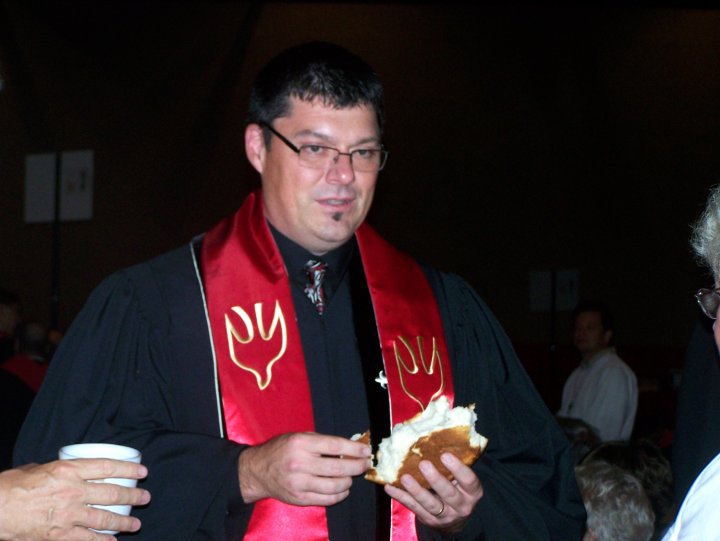
First time serving communion as an Ordained Elder, at the service at which I was ordained.
Honestly, it was an emotionally wrecking experience. I don’t expect our Conferences to mollycoddle us through the process, but it shouldn’t feel like The Hunger Games, with the game makers (BoOM) throwing up obstacles and additional hoops for us to jump through, either.
We’ve got to reform this process. And when I say reform, I don’t mean tweak it. I mean clean out the fridge. Take everything out, scrub the fridge, and start putting back only the bits that belong. And throw everything else onto the compost heap, down the garbage disposal, into the trash. I’ve seen the UMC lose good candidates to other denominations because of our entirely-too-cumbersome process and our devotion to it. I’ve seen it breed bitterness and cynicism among those who have completed it.
I’m married to a Seattle girl. I love that city and its suburbs. I love the food, the artistic landscape (there’s art and music everywhere), the open embrace of diversity, the “green all year” climate, the Pike Place Market, the Puget Sound, the fresh salmon, coffee everywhere, and – oh, yes – the woman who fell in love with me and moved along with her daughter (whom I also love dearly) to Illinois to marry me. I love Tiffany’s whole family. I love her dad in Great Falls, Montana and how he reminds me of my own dad in so many ways. I love her mom and her stepdad in Seattle. I also love Tiff’s ex-husband, her daughter’s father, who is gracious, caring, and sweet.
And there’s the football. Tiff’s friends and family are Seahawks fans. I didn’t really follow (or even understand) football have a team prior to our marriage, but we’ve been excited to watch the Hawks these last few years.
Our family had a great time Sunday night watching the Seattle Seahawks beat the San Francisco 49ers to advance to the Super Bowl this past Sunday night. It was an exciting game, a real nail-biter. It literally came down to the last play in the final seconds of the game. Colin Kaepernick threw what looked for all the world like a touchdown pass to Michael Crabtree in the corner of the end zone. But Richard Sherman sprang up and got a hand on the ball before it could hit Crabtree, forcing an interception by Malcolm Smith that helped the Seahawks hold the lead until the clock ran out.
Then Sherman gave the interview. You know the one. And the internet blew up. It’s still blowing up. Everybody has an opinion on Richard Sherman’s sportsmanship, character, and attitude.
And I’m about to give you mine.
This reflection is based on a book I am currently reading. It’s called Mindset: The New Psychology of Success by Carol Dweck. The essential thesis of the book is simple. There are two basic mindsets that one can adopt, two attitudes toward success and failure that play a huge role in one’s approach to problem-solving and career-building. The first is called a “fixed” mindset, and it’s the attitude that things like intelligence, problem-solving ability, and talent are innate, fixed characteristics. Success and failure reflect upon the intelligence, character, and innate abilities of the person. The second is identified as the “growth” mindset. Failure is perceived not as a reflection upon one’s character or talent, but as a challenge to learn from and overcome. Dweck reflects upon the lives and careers of athletes, businesspersons, academics, and others who represent, to one degree or another, each of the two mindsets.
To make a long story short, failure sends a fixed-mindset person to the cry room. The fixed-mindset person will make excuses or try and cover up his/her failures. She or he will take every failure, every loss personally as if it reflects poorly upon their character, talents, and abilities. On the other hand, failure sends a growth-mindset person to the practice field or the woodshed.
(Of course, this is an oversimplification. Success begins with an interplay between one’s innate characteristics and chosen mindset, along with a dose of advantages/disadvantages that are beyond each individual’s control. Those with a growth mindset may be limited to some degree by external disadvantages, but refuse to be defined by them.)
Something tells me that Stanford professor Carol Dweck would place Stanford graduate Richard Sherman in the “growth-mindset” category.
I started thinking that when I saw this article pop up on my Facebook feed. From the article:
Sherman thrived on the field, as well. He played tight end for Dominguez [note: his high school] and attracted scholarship offers (as a receiver) from numerous colleges. Stanford’s academic reputation hooked Beverly [his mother], and its status as a bottom feeder appealed to Sherman’s competitive streak.
“I wanted to go somewhere and be part of the change rather than a place that was already winning,” he said.
He chose to attend an academically challenging school and committed himself to doing his part to turn around their football program. I interpret this as a growth mindset challenge. Rather than join a team that was steamrolling the competition, Sherman chose a team where he’d have to learn to win.
Also:
Sherman’s unrelenting need to prove people wrong developed early. His older brother, Branton, who now serves as full-time business manager, was always his part-time instigator.
“He used to piss me off all the time,” Sherman said with a smile. “He still does. He’ll say, ‘This guy’s way better than you are. He’s going to beat the heck out of you.’
“And I just go out to prove him wrong, like: ‘Shut up! Shut your mouth! I stopped this dude. I stopped that dude.’
“But no matter who I stop, he’ll say, ‘This guy’s rated here. He’s going to go for 200 on you today. He’s better. He’s waaaay better than you.”
It’s that mindset, that attitude that sends Sherman to the practice field, that motivates him to push himself harder, work longer hours, to face each game as a challenge to rise to and an obstacle to overcome.
Sherman grew up and attended high school in Compton. He was a straight-A student, salutatorian of his graduating class, completed his Communications degree at Stanford, chose to play a defensive position because, in his words, at defense “you’re in control of your own destiny,” rose above the expectation that he’d be an average NFL player, and pushes himself at every opportunity to improve his game. After retiring from the NFL, he plans to put his communications degree to use as a sports commentator (he has well-defined career goals for someone who is 25 years old!)
So maybe he comes across as a loudmouth. But maybe running his mouth is his way of setting goals for himself, raising the bar of success so that he’s continually challenged to rise above. And maybe there’s something we can all learn from that.
Every month I write a church column for the local newspaper. Here’s this month’s entry.
“You’ve got three years, starting today.” That was the challenge issued by a friend of mine several years ago. “Imagine you got a call from the Bishop, and he told you that you have three years left in your current church. And you will not be replaced by a new pastor. What’s your plan for leaving behind a church that is vital, self-sustaining, spirit-guided, thriving, and growing?”
Think about that from your perspective. What if the powers-that-be in your church told you that after three years you’re losing your pastor, there will be no new pastor, and that your church is expected to be vital and growing anyway? What does that vital and growing future look like? Who is doing the work of the church? Who’s visiting the sick? Who’s leading book studies and Bible studies? Who’s working with the kids and young families? Who’s giving the Sunday message? Who’s following up with new visitors? Who’s keeping the calendar? Who’s in charge of music?
I experienced that once. My pastor died while he was serving our church. He was a great leader and a courageous man. Unfortunately, he was also a man with serious heart problems. We all knew his health was a concern, so members of our congregation took over pieces of what we thought was the pastor’s job. And when he died, we were left without a pastor for six months. And during those six months the church actually grew. We discovered that much of what we thought was his job was really the church’s job, our job. We learned to be a church, and in doing that we learned that ministry is everybody’s business.
If you are a member of a church, then you are (or should be) in ministry. What is your ministry? To what kinds of ministry do you feel called? To whom can you look for guidance in discerning your call? And what if you only had three years to prepare your church for vitality without pastoral leadership? Blow your pastor’s mind sometime: march into his or her office and ask, “How can I help you?” Then take up that ministry with a sense of urgency and joy.








 Joy in a Minor Key